

Synopsis
This challenge revolves around analyzing a malicious Linux kernel module provided in the form of a .ko file, accompanied by log files. The kernel module functions as a keylogger, silently capturing and logging keystrokes entered by the user.
Description
A devastating data breach has occurred, compromising one of our most secure systems. The breach has been codenamed **Colossal Breach**, reminiscent of the overwhelming force of the Colossal Titan, breaching our digital walls with unprecedented power. Our forensics team recovered a suspicious kernel object file (`.ko`) and encrypted log files from the compromised machine. Initial analysis suggests that the attackers installed a keylogging kernel module to capture sensitive credentials and exfiltrate data unnoticed.
As a member of the elite forensics squad, your mission is to analyze the kernel module and log files to uncover the attack.
Enumeration
For this challenge, players are given the .ko file and logs of the keylogger.

Solution
[1/7] Can you identify the module’s author?
The first step in analyzing the .ko file is to gather metadata using the modinfo command. This will provide valuable information about the module, including the author’s name.
modinfo brainstorm.ko
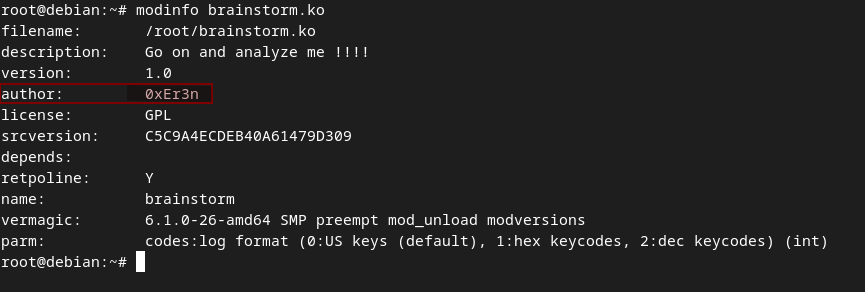
Answer: 0xEr3n
[2/7] Can you determine the exact function used to register the module’s notifier block?
In the disassembly of init_module, we can observe the function register_keyboard_notifier() being invoked to register the notifier block. This function is called so that the notifier block is registered as part of the initialization routine for handling keyboard events. Therefore, register_keyboard_notifier() is the function responsible for registering the notifier block within init_module.
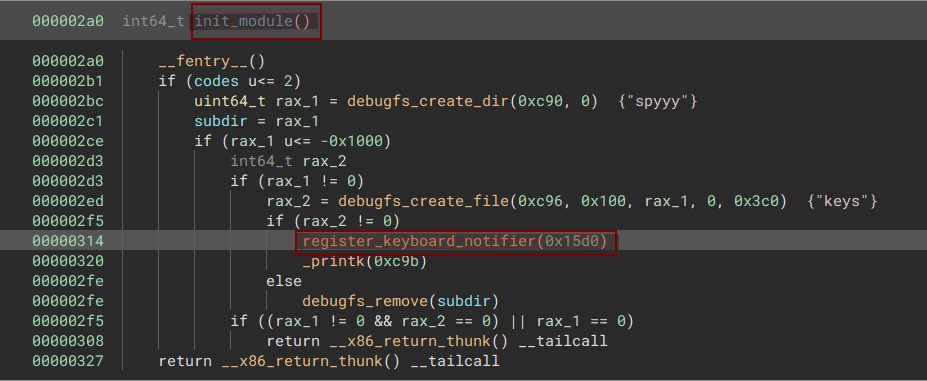
Answer: register_keyboard_notifier
[3/7] What is the name of the function that converts keycodes to strings?
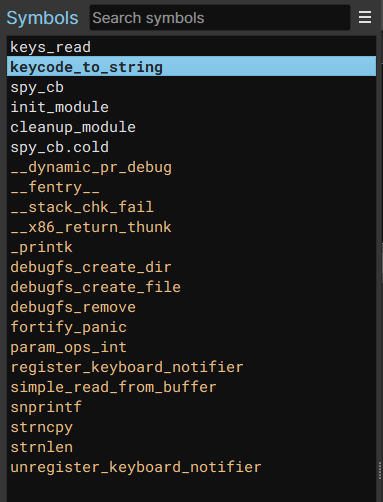
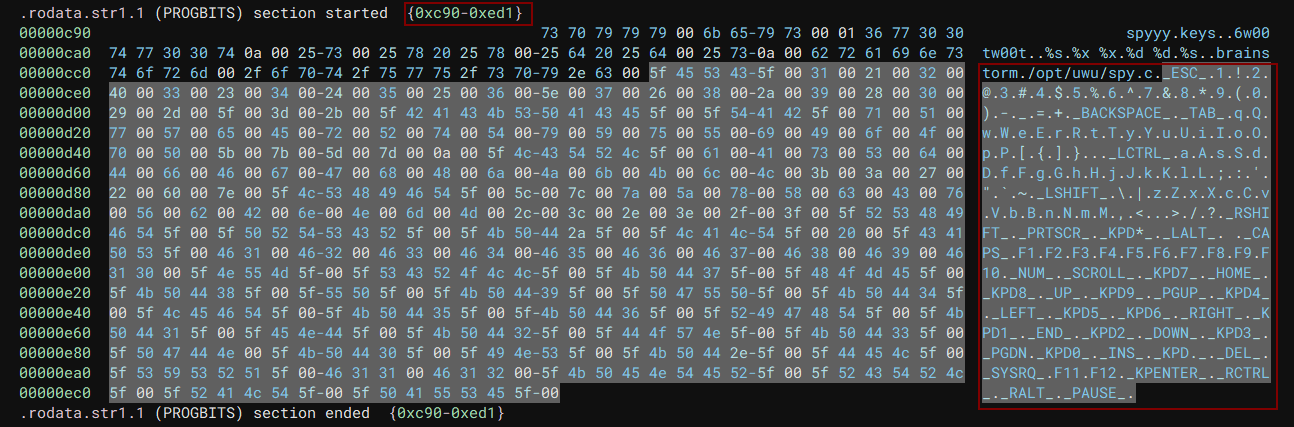
Going through all the functions, we find this uniquely named function called keycode_to_string.
The function converts raw keyboard input into a readable format by referencing predefined keycodes in memory. It checks the input validity based on the event type stored in rcx and the input parameters’ ranges. Depending on the value of rcx, it uses snprintf to format the output as either hexadecimal or decimal strings. Keycodes are retrieved from specific memory offsets calculated from rdi, allowing for the effective transformation of raw keypress data into structured output.
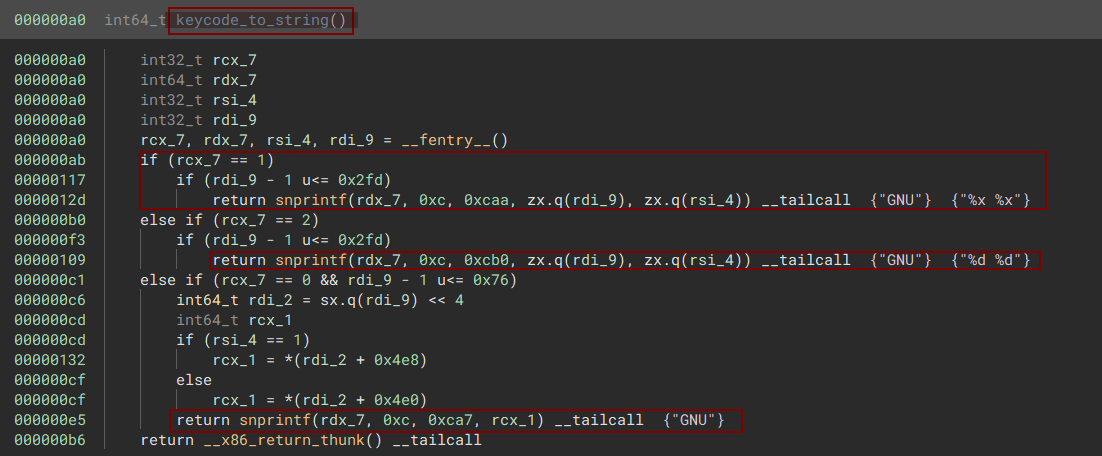
The keycodes are stored in memory and are being used to convert the keystrokes.
Answer: keycode_to_string
[4/7] Can you identify any specific kernel functions or APIs that this module uses for storing the keystrokes?
Again looking into the spy_cb function we can identify this piece of code which is responsible for storing keystrokes.
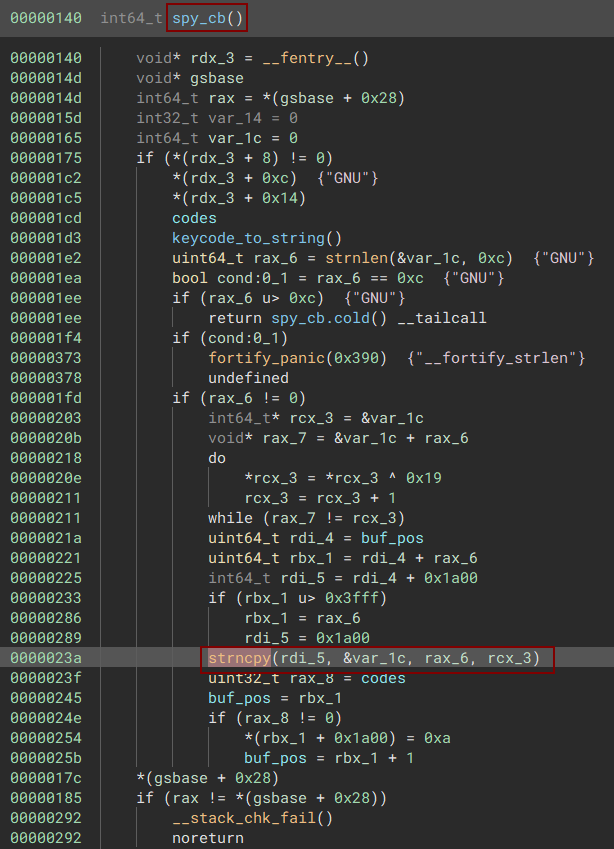
The function stores keystrokes in a buffer tracked by buf_pos, which indicates the current position for new data. It calculates the new position by adding the length of the incoming key representation (rax_6) to buf_pos, resulting in rbx_1. Before storing, it checks if rbx_1 exceeds the buffer length (0x3fff) to prevent overflow; if so, it resets rbx_1 to rax_6. The function then uses strncpy to copy the formatted keystroke data from var_1c into the buffer at position rdi_5, ensuring the length copied is rax_6. Finally, it updates buf_pos to reflect the new position for subsequent keystrokes.
Answer: strncpy
[5/7] What specific files does this module create for the storage of logs? Provide the full path.
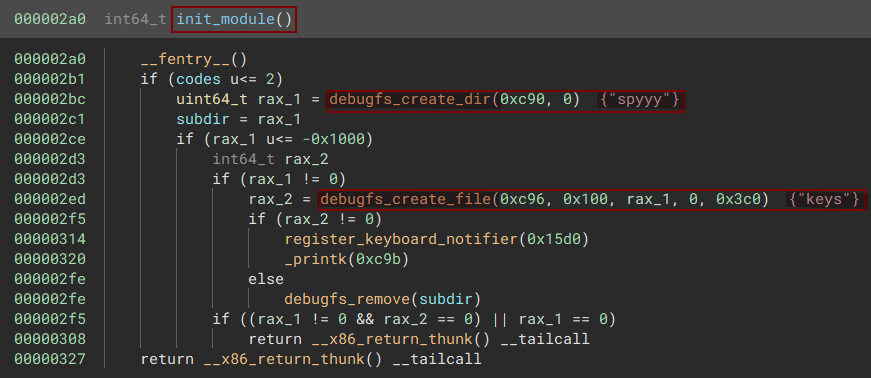
The init_module() function creates a debugfs file named keys within a directory called spyyy, which is used for logging keystrokes captured by the module. Debugfs is a virtual filesystem in the Linux kernel primarily used for debugging and monitoring purposes, providing an interface for kernel developers and system administrators to access kernel-related information. The keys file serves as a writable log, allowing the kernel module to store formatted keystroke data in real time.
Answer: /sys/kernel/debug/spyyy/keys
[6/7] What is the message printed by the module when it is imported?
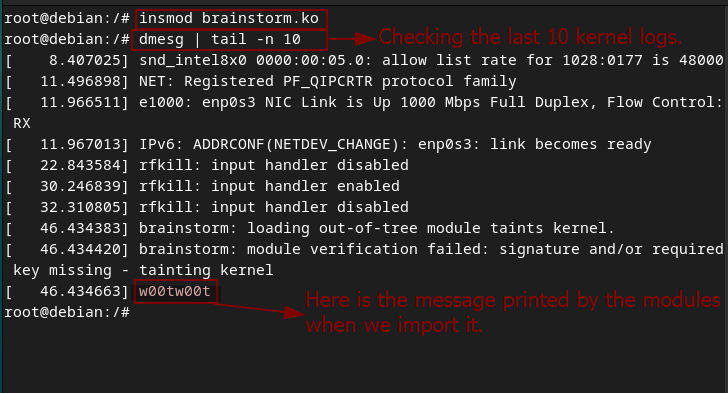
We can find this by analysing the kernel logs after importing the kernel module on our own. Once we have inserted the kernel module, we can check for printed messages by the module in kernel logs using dmesg.
Answer: w00tw00t
[7/7] What is the password for Adam found in the keylogger’s log?
Analyzing all the functions, we can understand that the logs are being saved in the /sys/kernel/debug/spyyy/keys file but they are in an encrypted form.
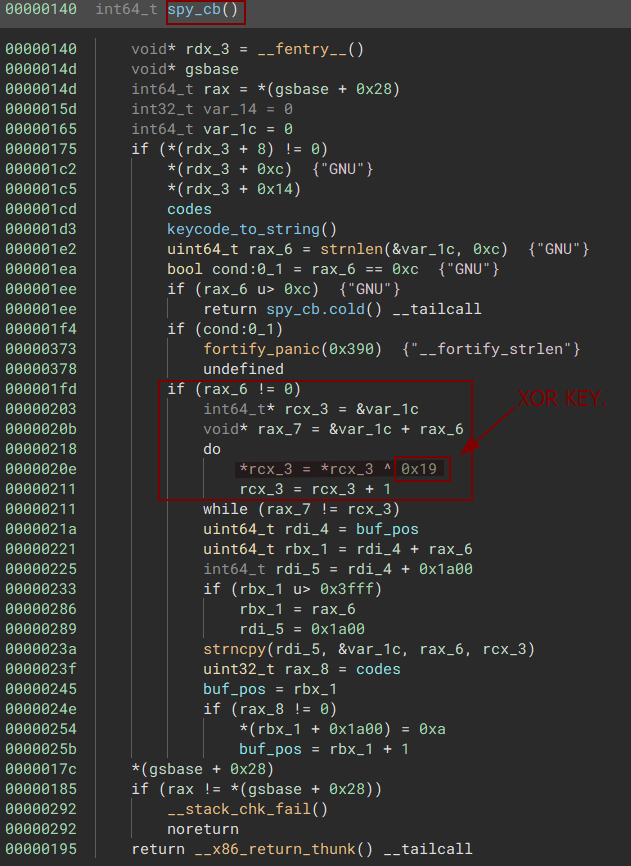
If we pay some attention to the spy_cb function, there is some modification with the processed keystrokes — it first determines the length of the input string stored in var_1c using the strnlen function, which stores this length in rax_6. If the length is greater than zero, the function sets a pointer, rcx_3, to the beginning of var_1c and calculates rax_7 to point to the end of the string.
A do-while loop is employed to iterate through each character of the string, where each character is XORed with a fixed key value of 0x19. This operation modifies the original keystroke data, effectively obfuscating it through a bitwise XOR operation.
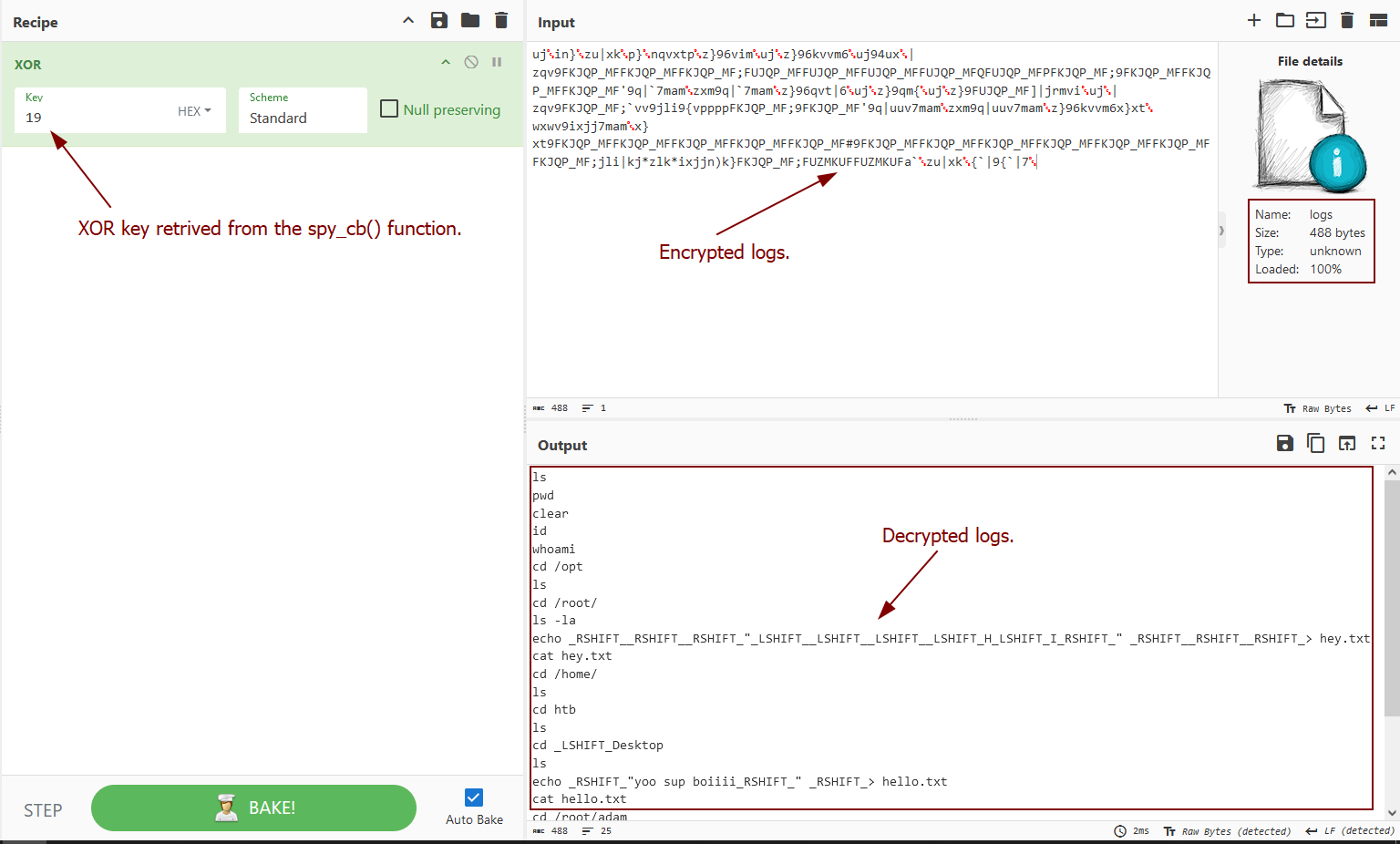
In order to decrypt the logs, we can use CyberChef.
Now that we have the logs, let’s check them for any password related to Adam. We find the password in the logs!
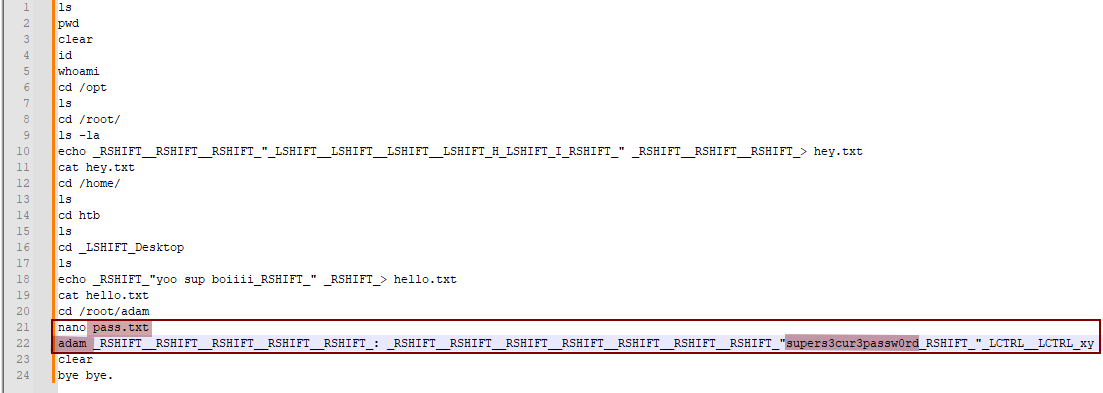
Answer: supers3cur3passw0rd